STÜKEN MEANS MORE
With our precision parts, we implement solutions that even experts would not have considered feasible. We combine complex technologies, finishing processes and services and achieve results that add value for our customers.
Menu
STÜKEN MEANS MORE
With our precision parts, we implement solutions that even experts would not have considered feasible. We combine complex technologies, finishing processes and services and achieve results that add value for our customers.
Contact
Hubert Stüken GmbH & Co. KG
Alte Todenmanner Str. 42
31737 Rinteln
Germany
Phone +49 5751 702 0
info@stueken.de
Further Contacts
Here you will find our international production and sales locations.

STÜKEN MEANS MORE Flexibility
Perfect in shape and extremely precise: We produce individual components for you from a variety of materials.
Whether in the automotive sector, electrical engineering, or medical technology: stamped and punch-bent parts are an indispensable part of craft and industry. While stamping just involves separating the material, punch-bending also bends and forms it into shape. But how exactly does it all work? What are the benefits of metal stamped parts and why is precision so important? You can learn more about these important manufacturing methods and get to know our operations here.
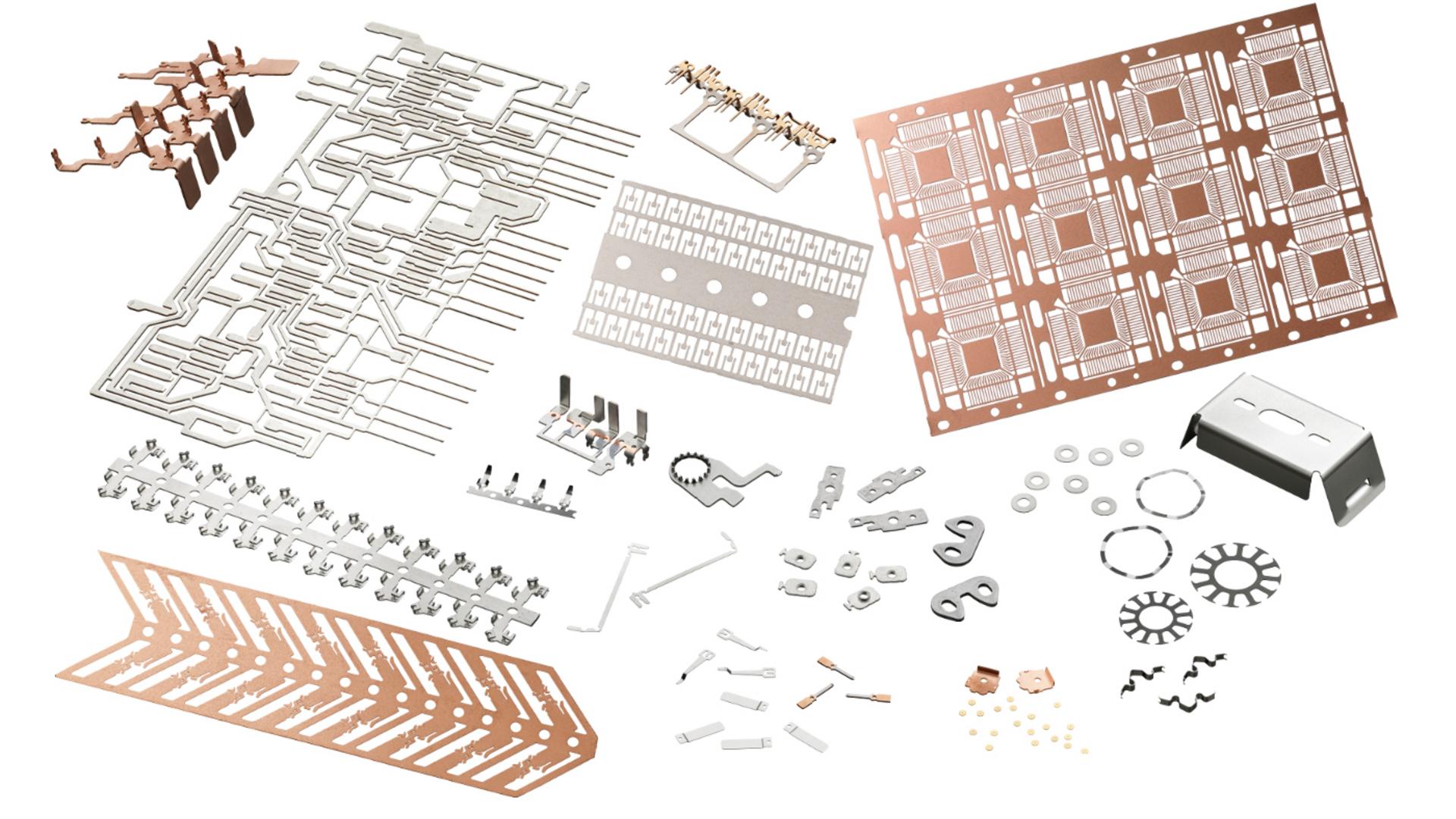
Stamping is a forming, manufacturing and separating process with a long history. While hundreds of years ago stamping was mostly used to make coins, modern industrial stamping methods enable a whole range of products to be produced. The process basically always follows a similar principle where the workpiece is pressed and cut (or stamped) between a punch and die at high force. The benefits include precise production, outstanding process accuracy, short manufacturing times, and the highest product quality.
Our production lines are set up to provide cutting-edge stamping processes for a variety of workpieces, allowing us to offer an enormous range of metal stamped parts for our customers.
Where are stamped metal parts used?
The range of potential applications is huge and shows just how flexible the process is. For instance, small stamped parts for use in electrical engineering are as common as robust metal formed parts for the automotive industry. Thus, you can find our precision-produced components in industry, skilled trades, mechanical engineering, the automotive sector and many other industries.
Classical stamping involves producing parts in various forms from metal sheets. The stamps and dies used define the dimensions and geometry of the product. Typical forms include perforated sheets, grilles, circles, ovals, rectangles and more. It is also possible to stamp recesses, slots, beading, lugs, threads and grooves, so there is a multitude of possible forms and form combinations.
The sheet thickness also determines the potential part geometry. For instance, stamping can produce components that are robust, solid and durable, or delicate and fine.
As mentioned, stamping technology provides a high degree of product flexibility. Not only can the shapes and thicknesses be adapted to suit any purpose, but the choice of material also plays an important role. There is a huge range of options in this aspect too, from popular alloys such as stainless steel to custom products made from tantalum or titanium. The resulting stamped parts each meet the highest requirements, for instance in respect to electrical conductivity and strength.
The materials we process at our facilities include:
Customers have specific requirements that we meet by deploying our process expertise. STÜKEN can offer in-depth advice on choosing the right material to ensure your stamped parts meet your specific wishes.
For instance, copper is used for stamped parts in products that require a good level of electrical conductivity. Typical copper stamped parts include plugs, lead frames, power rails and contact plates. Stainless steel offers a particularly wide range of uses for stamped parts. It is corrosion-resistant, hygienic, and hardy, which makes it ideal for many different components.
Thanks to its ductility, metal is particularly well suited to stamping and punch bending. Ductility means that the material can be formed, and that form is then preserved.
Aluminum stamped parts have proven themselves to be an effective solution for modern applications. Along with iron and copper, this lightweight metal is among the most frequently used raw materials for stamped parts.
There are several reasons for this fact. For instance, aluminum is generally strong but at the same time low in weight, which makes it ideal for fields such as aeronautical engineering. Aluminum is also extremely resilient thanks to a protective oxide layer that forms on its surface. It can be even further reinforced through anodic oxidation. Last but not least, aluminum is also a visually appealing option for many customers. With that in mind, we offer an alkaline matting option to suit your application.
Are you interested in metal stamped parts made from aluminum? It is one of the metals we specialize in, and we would be happy to advise you on your specific production requirements. Benefit from our expertise and let us produce your high-precision aluminum components.
There are a wide range of basic materials for metal stamped parts. The raw material selected generally has to meet the product requirements, i.e. its thickness or surface properties are not changed by the stamping process, only its shape. Below you can find information about the basic materials used by STÜKEN.
Stamped metal sheets are particularly common intermediate products. They can be used to produce components for automobiles, machines, aeronautical engineering products, and more.
Stamped metal sheets are also ideal for housing, packaging, covers and other similar purposes. The parts can also be further modified by perforating, cutting, embossing, notching, or grooving. In this respect, high-quality metal sheets provide a high level of flexibility.
Stamped metal strips are processed in a very similar way to metal sheets. They are primarily used when the product is to a strip (that is, it has an elongated, rectangular basic geometry). One typical use is in stamped door strips. However, there are many other processes where strips are stamped, such as the production of electronic components.
The metal stamping is a simple principle and has been applied for hundreds of years. The metal is placed between two robust tools called the punch and die. These tools move towards each other depending on the process, with high force and/or at high speed with the edges cutting through the material in the process and the stamped part is finished.
Although it basically sounds quite simple, the process can be quite complex in some cases (for instance, when the requirements for precision, robustness or dimensional accuracy are particularly high). Our machine fleet includes a variety of automatic stamping presses, specialty cleaning and finishing systems, cutting-edge automation technology and peripheral devices for meeting customer requirements, allowing us to produce the highest-quality precision-stamped parts in series production.
Nowadays, metal stamped parts are produced with sophisticated automatic stamping presses. Key factors include the table size, pressing force, drive, pressing surface, and work area. We also have hydraulic stamping presses that primarily differ from automatic stamping machines by their degree of automation. However, the terms are still sometimes used synonymously.
Our machinery is capable of manufacturing both delicate electronic components and robust molded parts for the automotive industry.
Precision plays a crucial role in production at STÜKEN. We ensure that the tolerance specifications in every production step are met precisely, which guarantees our customers precise and dimensionally stable components from the first part to the last.
Stamped part tolerances mean that the dimensions (length, angle dimensions, symmetry and others) may vary slightly. Such deviations or tolerances are specified in millimeters. As an example, the tolerance ±0.2 mm means that the stamped part produced may be 0.2 mm longer or shorter.
Variation must be kept as low as possible to aim for ensuring the functionality of the end product in which the stamped parts are used. As a general rule, the smaller the stamped part, the less variation can be tolerated. High-precision parts are essential for durable, efficient and low-maintenance end products. Tolerances are so important to stamped parts that a dedicated standard, DIN 6930-2, defines the specific requirements involved.
As well as stamping, STÜKEN also specializes in punch bending. The crucial difference between these processes is that punch bending involves punching and bending in the same process. This produces complex components that meet even more in-depth requirements. To give you a greater insight into the punch bending process, we have depicted it below.
Punch bending consists of two processes that are entwined and often performed in parallel. One is stamping, where a formed part is separated from a metal sheet, strip, or wire, additionally, the part is reshaped through bending. The process is generally used for metal sheets, but we can also produce end products with other material properties, for instance by punch-bending hollow workpieces.
More specifically, specialists differentiate between the inner and outer contours and the final bending contour. The inner and outer contours are stamped, while the final bending contour is bent.
Punch-bent parts are used to produce complex end products in many branches of industry including
and many other sectors.
As is the case with stamping production, a variety of metals and alloys are suitable for production of stamped and bent parts.
The materials used most frequently are:
Spring steel is a material with special properties. While many metals are rather brittle, spring steel has a high level of elasticity, which means it can be used to produce components with a restoring force. Such properties are used to construct switches in electrical engineering, for instance, or to produce seals or springs.
Punch bending is particularly well suited to making durable and reliable spring-steel components.
STÜKEN predominantly uses sheet metal strips called coils for punch bending. Coils are a wound, flat raw material that is shaped into the desired geometry during the production process. Depending on the primary material, products achieve different properties with respect to rigidity, strength and durability. If necessary, pre-coated coils can also be used for the stamping process.
The combination of suitable raw materials with a tried-and-trusted method makes punch bending the ideal solution for series production of precision components. The outcome is huge quantities of products of consistent quality in the shortest time possible.
STÜKEN produces punch-bent parts in one combined process. The following steps are generally performed one after the other.
1. Cutting
In the first step, the components are given their outer and inner contours in the strip. This step allows for very specific geometries.
2. Bending
The next step is to reshape the cut geometries, which produces three-dimensional components that are cut, stamped, and bent to suit the applicable purpose or use.
3. Cleaning (optional)
In most cases, the component is then cleaned to remove oil and metal filings. STÜKEN offers options including PER cleaning, aqueous solutions, ultrasonic, and plasma cleaning.
4. Finishing (optional)
Following the punch bending process, the surface of the component can be finished (for example, by coating it for greater corrosion resistance). Other options include surface hardening using the STÜKEN SWEP® process, matting, laser marking, and more.
The particular benefits of punch bending technology are high productivity and cost efficiency. Our production lines can produce large quantities of your components to meet your requirements, with maximum precision and optimal material utilization.
Just as with stamped parts, punch-bent parts have important tolerance requirements for ensuring component functionality. There are three-dimensional tolerances as well as geometric ones, which means that not only the stamping process, but also the bending process requires the highest degree of precision. Our production tools offer the level of accuracy required to maintain extremely tight tolerances.
Some useful information: tolerance classes in accordance with DIN ISO 2768
It stands to reason that components in precision engineering require a higher level of dimensional accuracy compared to rougher workpieces for mechanical engineering. The tolerance classes defined in DIN ISO 2768 were established for this reason. They offer reliable reference points for product quality that manufacturers and customers can use as a guide.
The tolerance classes are: fine (f) medium (m) coarse (c) very coarse (v)
In this context, fine (f) represents the tightest tolerances.
In summary, punch bending is an ideal process for producing high quality parts in large quantities. The sophisticated stamping tools in our production facilities are designed to precisely produce complex workpieces with individual geometries in the most effective way possible. The component can be formed from the side, above, or below, allowing a full range of three-dimensional geometries to be produced.
There are a variety of processes for producing components from metal sheets or strips. Stamping and punch bending processes are particularly cost efficient compared to alternatives such as laser cutting. Once the tools have been created, production can be scaled to practically any level. Our customers benefit enormously from this advantage, particularly when it comes to large-scale series production. Please feel free to contact us for advice on your specific circumstances and a non-binding quotation.
Whether in a machine or an electronic device, high dimensional accuracy and minimal variation from nominal values are to aim for ensuring functionality. Stamping technology is a superior solution in this regard, too. It enables the production of metal components with tolerances down to the thousandth. Our in-house tool technology lets us maintain this level of precision even with high production quantities.
It generally takes just a few seconds to punch-bend a component in the automatic stamping press, even if the geometries involved are complex and three-dimensional. Combined with short cycle times, that means a high number of components can be produced at speed.
So stamping and punch bending help you to minimize your production times.
Modern stamping and bending processes are a pillar of industrial metal processing. Once the tools have been made, it can ramp up to series production. The higher the quantity, the more efficient the process is for each component.
Stamping processes are very sustainable. The level of material consumption is low because the stamping process is optimized to ensure only minimal waste is produced. Furthermore, metal stamping saves a lot of energy in comparison to other separating processes (such as cutting or laser-cutting). All in all, stamping production is an economical and environmentally friendly process for manufacturing precision components.
Spring, switch, grille, cover, perforated hole, or custom geometry: stamping and stamping-and-bending lets you create a multitude of different products in any custom size. Additionally, the use of different materials opens up even more options for acquiring tools that meet your specific needs. We are happy to take care of your specific requirements and provide some personal advice.
Extensive production options
We use high-performance automatic stamping presses with compressive forces ranging from 18 to 400 metric tons to process a variety of materials in thicknesses of 0.01 mm to 5 mm. We would be delighted to expand our machine fleet to meet your special requirements, just get in touch.
Extensive production options
We use high-performance automatic stamping presses with compressive forces ranging from 18 to 400 metric tons to process a variety of materials in thicknesses of 0.01 mm to 5 mm. We would be delighted to expand our machine fleet to meet your special requirements, just get in touch.
Creating value at the highest level
We do much more than just stamping components: we offer fully solutions including plastic injection molding, assembly production, and a multitude of finishing processes.
Creating value at the highest level
We do much more than just stamping components: we offer fully solutions including plastic injection molding, assembly production, and a multitude of finishing processes.
Economic efficiency in mind
At every stage from tool making to series production, we aim for maximum efficiency. Optimized material consumption is equally beneficial to our customers and the environment.
Economic efficiency in mind
At every stage from tool making to series production, we aim for maximum efficiency. Optimized material consumption is equally beneficial to our customers and the environment.
Flexibility thanks to in-house tool making
We generally produce all our tools in-house so we can tailor them exactly to the qualities and quantities required and even make the production of lower quantities of components economical.
Flexibility thanks to in-house tool making
We generally produce all our tools in-house so we can tailor them exactly to the qualities and quantities required and even make the production of lower quantities of components economical.
Are you looking for a partner to supply high-quality stamped products for industrial production? If so, feel free to contact us at any time. As a provider of holistic solutions, we are here to help you at every stage, from tools to producing punch-bent parts on your behalf.
We are at your service –
contact us
Do you have any questions about our range of services or the areas of applications in the field of stamping and forming? We support you because STÜKEN MEANS MORE partnership info@stueken.cz